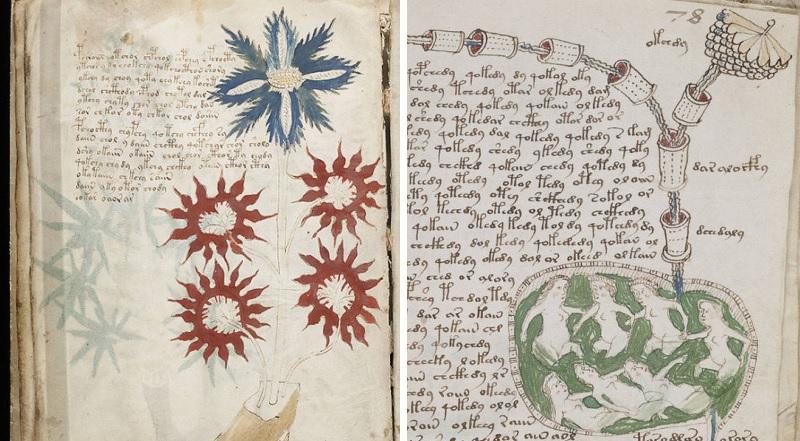
The Voynich Manuscript is a heavily illustrated handwritten codex first discovered in 1912, and carbon dated to the 15th or 16th century. The manuscript is believed to have been written in Central Europe and is named after the Polish-American antiquarian bookseller, Wilfrid M. Voynich, who acquired it in 1912.
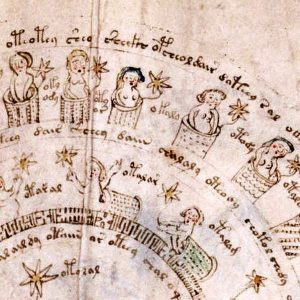
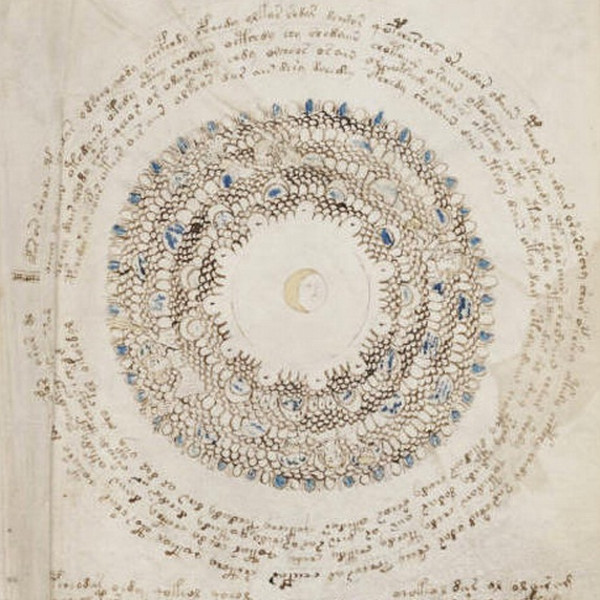 The mysterious text is rendered in an as yet undeciphered language or code, and almost every page contains illustrations of plants, astronomical symbols, nude women and cosmological medallions.
The history and origin of the codex, like the text itself is a hotly contested mystery, with some claiming that the manuscript was the work of Roger Bacon. The Voynich Manuscript is currently preserved in the Yale University Library as part of the Beinecke Rare Book and Manuscript collection.
Terence McKenna has given public talks about the mysterious Voynich Manuscript, which are available as YouTube videos, or in a transcribed text version.
There have been numerous unsuccessful attempts over the years to decipher The Voynich Manuscript by many individuals and also American and British intelligence agencies. More recently a claim has been made by a historical researcher to have deciphered the encoded text as a woman’s health guide.
“Since its discovery in 1912, the 15th century Voynich Manuscript has been a mystery and a cult phenomenon. Full of handwriting in an unknown language or code, the book is heavily illustrated with weird pictures of alien plants, naked women, strange objects, and zodiac symbols. Now, history researcher and television writer Nicholas Gibbs appears to have cracked the code, discovering that the book is actually a guide to women’s health that’s mostly plagiarized from other guides of the era.” – Annalee Newitz via ArsTechnica
 The Voynich Manuscript is available for viewing online at the resources below.
http://beinecke.library.yale.edu/…/highl…/voynich-manuscript