Eileen McKusick is a researcher, educator and sound healer who has been studying the effects of audible acoustic waves on the human body for around 17 years. A dedicated researcher, McKusick has written several times about the subject, including the book Tuning the Human Biofield: Healing with Vibrational Sound Therapy, and taught a public college course on sound healing at Johnson State College in Johnson, Vermont.
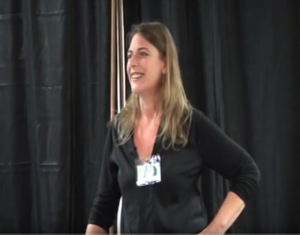 In addition to providing a delivery medium for McKusick’s research findings in Biofield Science, the progressive Johnson State College also has the distinction of being the first undergraduate degree program in wellness and alternative medicine.
In a lecture at the Globe Sound Healing Conference in Oakland, CA September 25, 2014, McKusick recounted the events which happened first through her massage therapy practice, and kindled in her the idea of using audible sound as an energy balancing and healing method.
“…I thought that when I activated a tuning fork and approached the body with it, that it would produce an objective tone, that it would sound the same, that it would be an input. What I didn’t expect was that the tone actually changed, as I moved it around the body it changed in pitch and volume and timbre. And it seemed to be that that change was reflective of what was going on in the body. So if somebody had pain in a particular area the tone would sound really sharp or it would sound really full of static.”
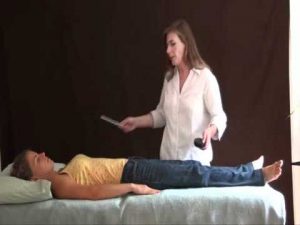 McKusick describes the resonant behaviour of tuning forks in her clients biofields, and how she interacts with them.
“…in addition to hanging out in areas that didn’t sound right, that were dissonant, I also discovered that there were particular areas where the tone would actually get loud. I would be passing over somebody’s hip and the volume would go up. And I thought if it was going to sound loud anywhere it should probably sound loud over the chakra. And I made this very curious discovery that I could kind of hook into these loud spots and move them, I could drag them. I call it click, drag and drop, it’s very much the same thing. If you’ve ever used a magnet to move iron filings, it kind of hooks in and drags them along, and that was really the sense.”
A happenstance event changed the scope and implications of the biofield for McKusick.
“…and then one day something happened that completely changed my whole practice. I was working on a person who was complaining that she had pain and a sense of pulling in her neck and her jaw and down into her shoulder. She had been through numerous treatments, she had tried different therapies, she’d seen an osteopath, and acupuncturist, massage therapist, and nobody had been able to help her.
So I was doing what I usually do and checking out the area close to the body, when there was this very loud noise out my window, so I walked over to the window and looked out and didn’t see anything. Then I turned around and activated the tuning fork right at the window and started walking towards her body with the tuning fork activated. And when I got to be about this far (3-4 feet) from her body I suddenly hit a loud spot. When I passed the tuning fork through it it got loud, and when it came out it got quiet.
I employed the click drag and drop technique and was able to pull this loud spot all the way back and drop it into her throat chakra. She went home and called me the next day and said “all of that pain and pulling is gone just like that.
When the next person came I started as far away as I could, about six feet away, and I started moving in towards the body, and I started finding all kinds of phenomena. There was this whole structure which seemed to be there”
And what began to emerge over years was what I call the Biofield Anatomy Map. It struck me that the human energy field appeared to have an actual anatomical structure to it, that it seemed to hold our memories in a very specific format.”
 Watch the rest here or click on video below.
Eileen McKusick’s book Tuning the Human Biofield: Healing with Vibrational Sound Therapy, tuning forks and related items including instructional resources can be found at the Biofield Tuning Institute.